
Water, carbonated drinks, and sauces require different monoblock filling machine designs. The key differences are mainly found in the pump system and filling head structure.
Water filling is simple and fast. It usually uses a centrifugal pump with clean and efficient filling heads. Carbonated drink filling also uses a centrifugal pump, but it requires pressure-controlled isobaric filling heads and gas management to prevent CO₂ loss. Sauce filling is more complex because the product is thick and sticky, so it commonly uses a peristaltic pump with anti-drip filling heads.
Product Characteristics: Decide the Filling Method
Before choosing a monoblock filling machine, you need to understand how the product behaves during filling.
Water flows easily and does not foam much. It can be filled quickly by gravity, pressure, or flowmeter filling. Carbonated drinks are more sensitive because gas can escape during transfer and filling. Sauce is much thicker, so it cannot be handled like water. It needs controlled pumping and filling heads that can prevent dripping, splashing, and product waste.
| Product Type | Main Feature | Filling Challenge | Common Pump | Filling Head Focus |
| Water | Low viscosity, no gas | High-speed stable filling | Centrifugal pump | Fast, clean, anti-splash |
| Carbonated drink/beer | Contains CO₂ gas | Foam control and gas retention | Centrifugal pump | Isobaric pressure filling |
| Sauce | High viscosity, may contain particles | Accurate dosing and anti-drip | Peristaltic pump | Wide-mouth, anti-drip filling |
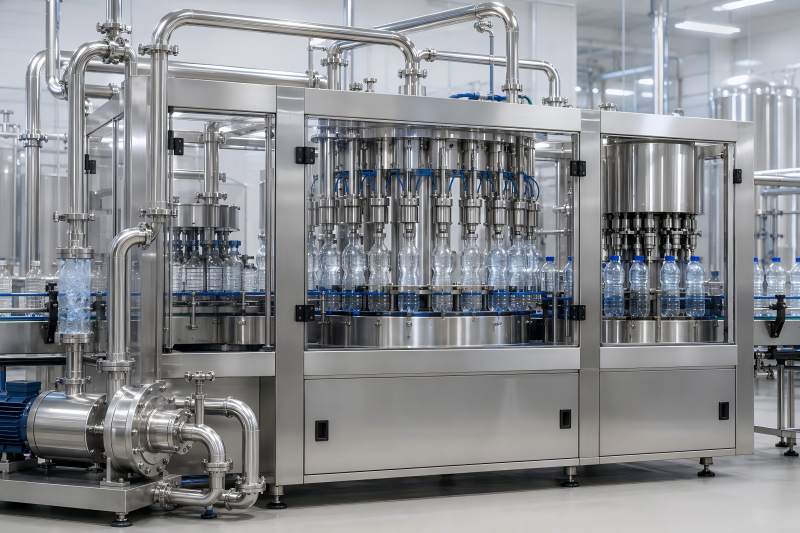
Water Monoblock Filling Machine
Water is the easiest product to fill among these three categories. A water monoblock filling machine is usually designed for bottled drinking water, purified water, mineral water, or still beverages without gas.
A typical water monoblock machine may include:
- Bottle rinsing
- Water filling
- Cap placing and capping
For water filling, the machine usually focuses on speed, hygiene, and stable liquid level control.
Pump Design for Water Filling
Water filling lines commonly use a sanitary centrifugal pump. The reason is simple: water has low viscosity and flows easily. A centrifugal pump can transfer water quickly and continuously from the storage tank to the filling tank.
The centrifugal pump is suitable for water because it provides:
- High flow rate
- Smooth liquid transfer
- Simple structure
- Easy cleaning
- Stable supply for high-speed filling
For water, the pump does not need to push thick material or handle particles. Its main job is to provide clean and consistent liquid supply.
Filling Head Design for Water
Water filling heads are usually designed for fast and stable filling. Depending on the machine design, the filling method may be gravity filling, pressure filling, or flowmeter filling.
Important filling head features include:
- Anti-splash design
- Smooth liquid outlet
- Accurate filling level
- Easy cleaning structure
- Food-grade stainless steel contact parts
Because water does not contain gas, the filling head does not need complex pressure balancing. The structure is simpler than carbonated filling heads.
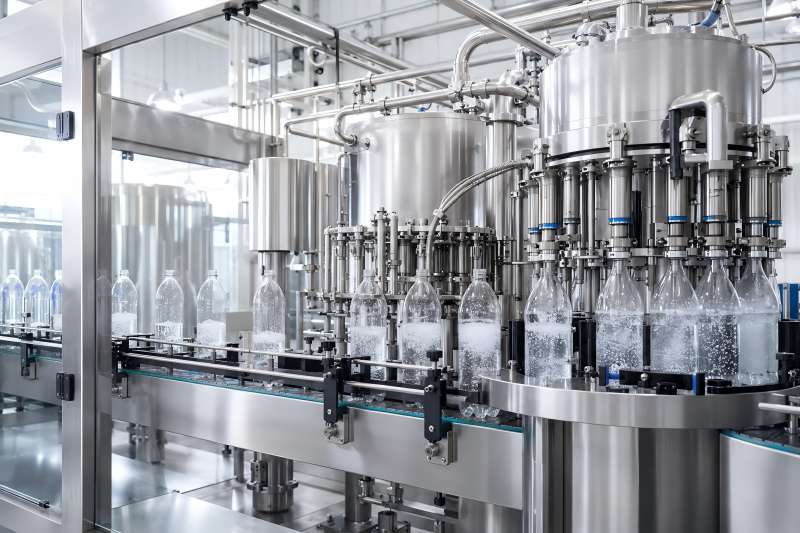
Carbonated Drink Monoblock Filling Machine
Carbonated drinks, sparkling water, soda, and beer need a different filling system. These products contain dissolved gas, usually CO₂. During filling, the gas can escape, causing foam, unstable fill levels, product loss, and poor taste.
Therefore, a carbonated beverage monoblock filling machine must control pressure carefully.
A typical carbonated drink filling process may include:
- Bottle rinsing
- Carbonated beverage filling
- Gas compensation or CO₂ headspace treatment
- Capping or sealing
For beer and some carbonated beverages, gas management is very important. During filling, part of the gas may escape. To maintain carbonation, reduce oxygen, and keep product quality stable, the machine may include an extra gas-related process, such as CO₂ flushing, headspace gas injection, or gas compensation before capping.
Pump Design for Carbonated Filling
Carbonated beverage filling also commonly uses a sanitary centrifugal pump for product transfer. Since carbonated drinks are usually low-viscosity liquids, a centrifugal pump can handle them efficiently.
However, compared with water filling, the pump system for carbonated drinks requires more careful control. The pump should avoid excessive turbulence because strong agitation can cause CO₂ to escape.
The pump system should support:
- Stable pressure delivery
- Smooth beverage transfer
- Low turbulence
- Sanitary operation
- Compatibility with pressurized tanks
Although the pump may still be centrifugal, the whole filling system is more complex because it must work with pressure tanks, CO₂ control, and isobaric filling valves.
Filling Head Design for Carbonated Drinks
The filling head is the key difference between water and carbonated drinks.
Carbonated drinks usually require isobaric filling heads, also called pressure filling valves or counter-pressure filling heads. The bottle is gas-pressurized to match the filling tank pressure. This helps prevent the beverage from foaming when it enters the bottle.
A carbonated filling head usually handles:
- Bottle sealing
- CO₂ pre-pressurization
- Counter-pressure filling
- Gas return
- Foam reduction
- Stable fill level control
This design helps keep carbonation inside the drink and reduces product loss.
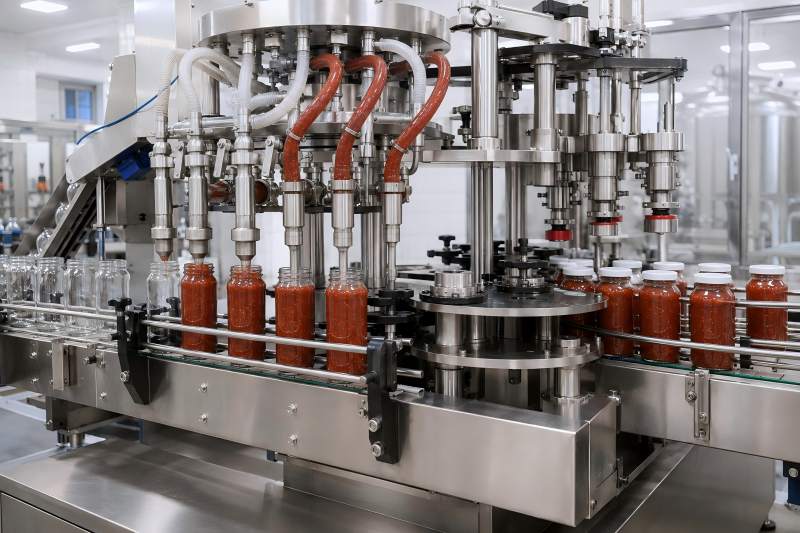
Sauce Monoblock Filling Machine
Sauce filling is very different from water and carbonated drink filling. Sauces may be thick, sticky, oily, or contain small particles. Examples include chili sauce, tomato sauce, ketchup, salad dressing, jam, syrup, honey, and seasoning sauce.
A sauce monoblock filling machine may include:
- Bottle or jar feeding
- Sauce filling
- Cap placing
- Capping
- Sealing or labeling connection
The biggest challenge is viscosity. Sauce does not flow like water, so it needs stronger dosing control.
Pump Design for Sauce Filling
Sauce filling can use a peristaltic pump, especially when the product needs gentle handling, clean transfer, and accurate dosing. A peristaltic pump moves product by squeezing a flexible tube. The product only contacts the tube, not the pump body.
This design provides several benefits:
- Gentle filling action
- Good hygiene
- Easy product changeover
- Reduced cross-contamination risk
- Good control for small and medium filling volumes
- Suitable for viscous or semi-viscous liquids
For sauce, the peristaltic pump is useful because it can move thicker products more accurately than a centrifugal pump. A centrifugal pump is good for thin liquids, but it is not ideal for thick sauce because it may lose efficiency and filling accuracy.
Filling Head Design for Sauce
Sauce filling heads need to prevent dripping, stringing, splashing, and blockage. Because sauces are thicker, the filling nozzle is usually wider than water filling heads.
Common sauce filling head features include:
- Anti-drip nozzle
- Cut-off valve
- Wider filling outlet
- Bottom-up filling option
- Easy disassembly for cleaning
- Compatibility with particles or pulp
For thick sauces, the filling head may go closer to the bottom of the container during filling. This reduces splashing and air bubbles. For sticky sauces, an anti-drip nozzle is very important to keep the bottle mouth clean before capping.
Main Differences in Pump Selection
The pump is one of the biggest differences between water, carbonated drinks, and sauce filling machines.
| Item | Water Filling | Carbonated Filling | Sauce Filling |
| Common Pump | Centrifugal pump | Centrifugal pump | Peristaltic pump |
| Product Flow | Easy and fast | Easy but pressure-sensitive | Slow and viscous |
| Main Requirement | High flow rate | Stable pressure and low turbulence | Accurate dosing and gentle transfer |
| Pumping Risk | Low | CO₂ loss and foaming | Dripping, blockage, inaccurate filling |
| Best For | Still water, purified water | Soda, sparkling water, beer | Sauce, syrup, dressing, paste-like liquids |
For water, the centrifugal pump is mainly used for fast and continuous supply. For carbonated drinks, the centrifugal pump must work with a pressure-controlled filling system. For sauce, the peristaltic pump is better because it gives stronger control over thick and sticky products.
Main Differences in Filling Head Design
The filling head directly affects filling accuracy, product appearance, and machine stability.
Water filling heads are simpler. They need to fill quickly and avoid splashing. Carbonated filling heads are more advanced because they need to seal the bottle, balance pressure, and control gas return. Sauce filling heads need anti-drip and anti-blocking functions.
| Filling Head Feature | Water | Carbonated Drink / Beer | Sauce |
| Filling Valve Type | Gravity or pressure valve | Isobaric pressure valve | Anti-drip dosing nozzle |
| Pressure Control | Low requirement | Very important | Usually not required |
| Foam Control | Not critical | Very important | Depends on product |
| Nozzle Size | Small to medium | Pressure-sealed design | Medium to wide |
| Special Function | Anti-splash | CO₂ pressurization and gas return | Anti-drip and cut-off |
| Filling Accuracy Focus | Liquid level | Liquid level and gas retention | Volume accuracy |
Why Carbonated Products Need Gas Management
Carbonated drinks and beer contain dissolved gas. During filling, the product moves from tank to bottle. If pressure drops too quickly, CO₂ escapes from the liquid. This creates foam and reduces carbonation.
To solve this problem, carbonated filling machines usually use several gas-control steps.
First, the bottle may be pressurized with CO₂ before filling. This creates a pressure balance between the bottle and the filling tank. Then the drink enters the bottle smoothly under pressure. After filling, the machine may also add a gas-related step, such as CO₂ headspace flushing or gas compensation, before capping.
This extra process helps:
- Reduce oxygen inside the bottle
- Maintain carbonation level
- Reduce foam overflow
- Improve taste stability
- Extend product shelf life
- Keep bottle pressure more stable
For beer, this step is especially important because oxygen can affect flavor and freshness. For soda and sparkling drinks, gas retention affects mouthfeel and product quality.
How to Select the Best Monoblock Filling Machine
When choosing a monoblock filling machine, do not only compare filling speed. You should first check the product type, viscosity, gas content, container type, and required filling accuracy.
Choose a water monoblock filling machine if your product is still water or low-viscosity non-carbonated liquid. A centrifugal pump and simple filling valve design are usually enough.
Choose a carbonated monoblock filling machine if your product contains CO₂, such as soda, sparkling water, beer, or carbonated juice. The machine should include isobaric filling heads, pressure control, CO₂ management, and possibly a gas compensation step.
Choose a sauce monoblock filling machine if your product is viscous, sticky, or contains pulp or particles. A peristaltic pump and anti-drip filling heads are more suitable for accurate and clean filling.